

The Great Train Wreck of 1918: Nashville Railroad History Reimagined
Posted by Sally Hendrick on Sep 15th 2026
On the morning of July 9, 1918, two passenger trains were traveling toward each other just west of downtown Nashville.
On the same track.
 At approximately 7:20 a.m., Nashville, Chattanooga & St. Louis Railway trains No. 1 and No. 4 collided head-on near a section of track known as Dutchman’s Curve. More than 100 people were killed and many more injured in what is widely considered the deadliest railroad accident in United States history.
The cause wasn’t one catastrophic mechanical failure. It was a series of human errors.
Train No. 4 was supposed to wait for the westbound No. 1 before proceeding onto the single track. Instead, it left Nashville. By the time the mistake was discovered, the two trains were already moving toward one another.
The impact was devastating.
Locomotives and cars left the rails. Wooden coaches splintered. Steel, timber and other railroad materials were thrown from the orderly path they had occupied moments before.
More than a century later, that history has particular resonance in Nashville, where reminders of the railroad that helped build the city are still all around us.
It’s also where Rail Yard Studios gives old railroad materials an entirely different destination.
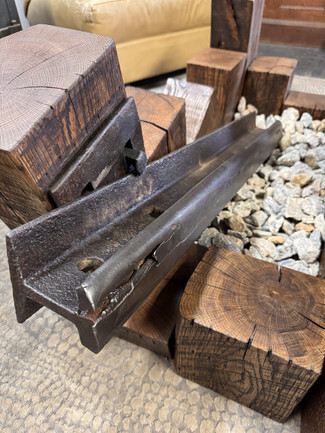
 Our Derailment Coffee Tables take inspiration from what happens visually when the railroad’s normally precise geometry is disrupted. Parallel rails cross unexpected paths. Timbers shift. Ballast scatters. Massive pieces of steel appear to have landed wherever momentum carried them.
But here, the chaos is carefully planned.
Authentic railroad materials are deliberately arranged beneath glass, turning the visual language of a collision or derailment into functional sculpture. The tables aren’t recreations of the Great Train Wreck of 1918—or any specific accident. Instead, they capture the tension between the railroad as it is engineered to be and the unexpected shapes created when things leave their intended path.
Every piece of rail, timber and stone once had a job to do.
Now those materials tell another part of the railroad story.
And in Nashville, where one of the most consequential moments in American railroad history happened just a few miles from our shop, that story is especially close to home.
Sometimes, it’s right underneath the glass.